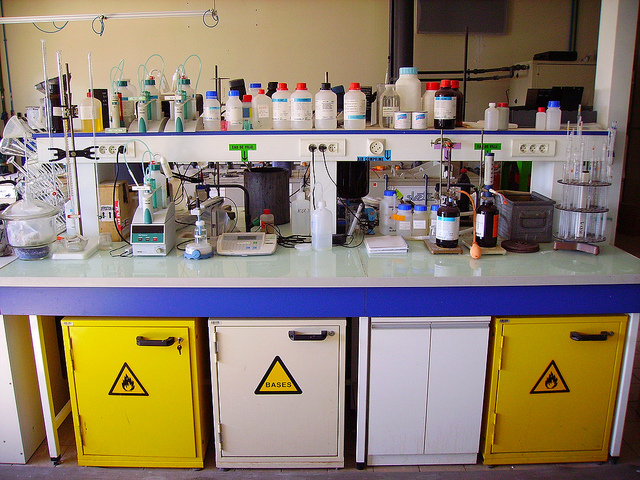
Federal and state laws govern “hazardous wastes”—the federal law is commonly called RCRA, after the Resource Conservation and Recovery Act of 1976. However, RCRA itself was enacted as an expansion of the prior Solid Waste Disposal Act of 1965, and requirements for both solid and hazardous wastes have been revised many times in recent decades. The US Environmental Protection Agency (EPA) administers these requirements nationally, delegating many provisions to individual states that qualify for authorization to assume regulatory roles.
Read More
Tags:
Business & Legal,
Health & Safety,
Environmental risks,
Environmental,
EHS,
Hazcom
Strategic planners around the world are preparing “climate change adaptation plans,” designed to identify their organization’s key activities and missions, evaluate how climate change might affect them, and develop organizational changes designed to anticipate and adapt in ways that preserve the organization’s performance. On October 31, the US Environmental Protection Agency (EPA) issued its own Climate Change Adaptation Plan. EPA’s divisions (Water, Air and Radiation, etc.) and 10 regional offices also issued plans covering their activities. These Plans provides a collective model for multi-level organizational plans, and also tell organizations in the US what help to expect from EPA when they plan for their own adaptations to climate change.
Read More
Tags:
Corporate Governance,
Business & Legal,
Environmental risks,
Environmental,
EHS,
EPA,
Greenhouse Gas,
climate change
STP Launches New Online Gap Analysis Tool
Auditors and Quality Managers across all manufacturing and service industries use ISO and OHSAS standards to put their Environmental and Health and Safety Management Systems into practice. These standards help implement effective and efficient EHS requirements, or VPP Occupational Health and Safety Management Systems. In this blog I review and summarize the two standards, their aims and obligations.
Read More
Tags:
Corporate Governance,
Business & Legal,
International,
Health & Safety,
Environmental risks,
Environmental,
EHS
We drive by the “Be Work Zone Alert” billboards all the time, reminding us to slow down and drive safe through road construction zones, with compassion-provoking reminders like, “Be alert, our mom’s at work.” And indeed, rather than feel annoyed at the roadwork construction that delays our driving progress, let’s continue to be mindful of the real risks that the workers face every day on the job.
Read More
Tags:
Corporate Governance,
Business & Legal,
Employer Best Practices,
Health & Safety,
Training,
EHS,
Transportation
Striving to meet wastewater compliance limits? Your treatment processes are only as good as the operators running your facilities—which is why every state and Puerto Rico have set specific operator certification standards for wastewater treatment plants. Do you know your state's requirements for:
Read More
Tags:
Corporate Governance,
Business & Legal,
Environmental risks,
Environmental,
EHS,
STC
Most Occupational safety and Health Administration (OSHA) electrical safety and machine guarding standards apply to protect employees from electrical and kinetic energy hazards during routine operations. But OSHA also requires protection during equipment servicing and maintenance, lest employees be injured by “unexpected” equipment energization, start up, or release of stored energy. OSHA’s Control of Hazardous Energy Standard—more often called the Lockout/Tagout or “LOTO” Standard after its primary compliance requirements—requires employers to establish and implement safety procedures to control such hazardous energy.
Read More
Tags:
Corporate Governance,
Business & Legal,
Employer Best Practices,
Health & Safety,
OSHA,
Employee Rights,
Environmental risks,
EHS,
Hazcom
The Occupational Safety and Health Administration (OSHA) has long required all employers to report work-related accidents that result in three or more deaths or serious injuries (what OSHA calls "catastrophes"). On September 18 OSHA published changes to these requirements that expand employers’ reporting requirements effective January 1, 2015 (I blogged about OSHA’s proposal here).
Read More
Tags:
Corporate Governance,
Business & Legal,
Employer Best Practices,
Health & Safety,
OSHA,
Employee Rights,
Environmental risks,
Environmental,
EHS
The Department of Consumer Affairs Bureau of Automotive Repair (BAR) wants you to know that taking the time to review your owner’s manual can ultimately save you time and money...and maybe even a few tears! These manuals contain maintenance and service guidelines that will help ensure the longevity of your vehicle. BAR explains the following reasons why you should read your owner’s manual:
Read More
Tags:
Corporate Governance,
Business & Legal,
Health & Safety,
Training,
EHS,
Transportation
OSHA regulates workplace air contaminants to protect employees from exposures to airborne chemical and particulate contaminants in workplace air. Generally, employee exposures are limited by permissible exposure limits (PEL) based on a time-weighted average (TWA) over an 8-hour workday. OSHA also allows exposure to some contaminants at greater “excursion limits” for short periods of time, subject to “ceiling values.” Many of these limits are based on voluntary standards developed by the American Conference of Governmental Industrial Hygienists (ACGIH).
Read More
Tags:
Corporate Governance,
Business & Legal,
Employer Best Practices,
Health & Safety,
OSHA,
Employee Rights,
Environmental risks,
Environmental,
EHS,
Hazcom
Increasing demand on British Columbia’s water systems has highlighted the need for a flexible yet robust legislative framework that balances ecosystem health, water supply, and competition for resources. The BC government has taken a major step toward adaptive water governance with the introduction of Bill 18, the Water Sustainability Act (WSA).1 Although WSA is only a broad framework and the government deferred many important details to future regulations, water users should be aware of the key changes it makes to the existing Water Act2 and prepare for compliance with WSA when it comes into force during spring 2015.
Read More
Tags:
Corporate Governance,
Business & Legal,
Health & Safety,
Environmental risks,
EHS,
Canadian